


How Switch Bills of Lading Support Cross-Trade and Protect Supplier Confidentiality
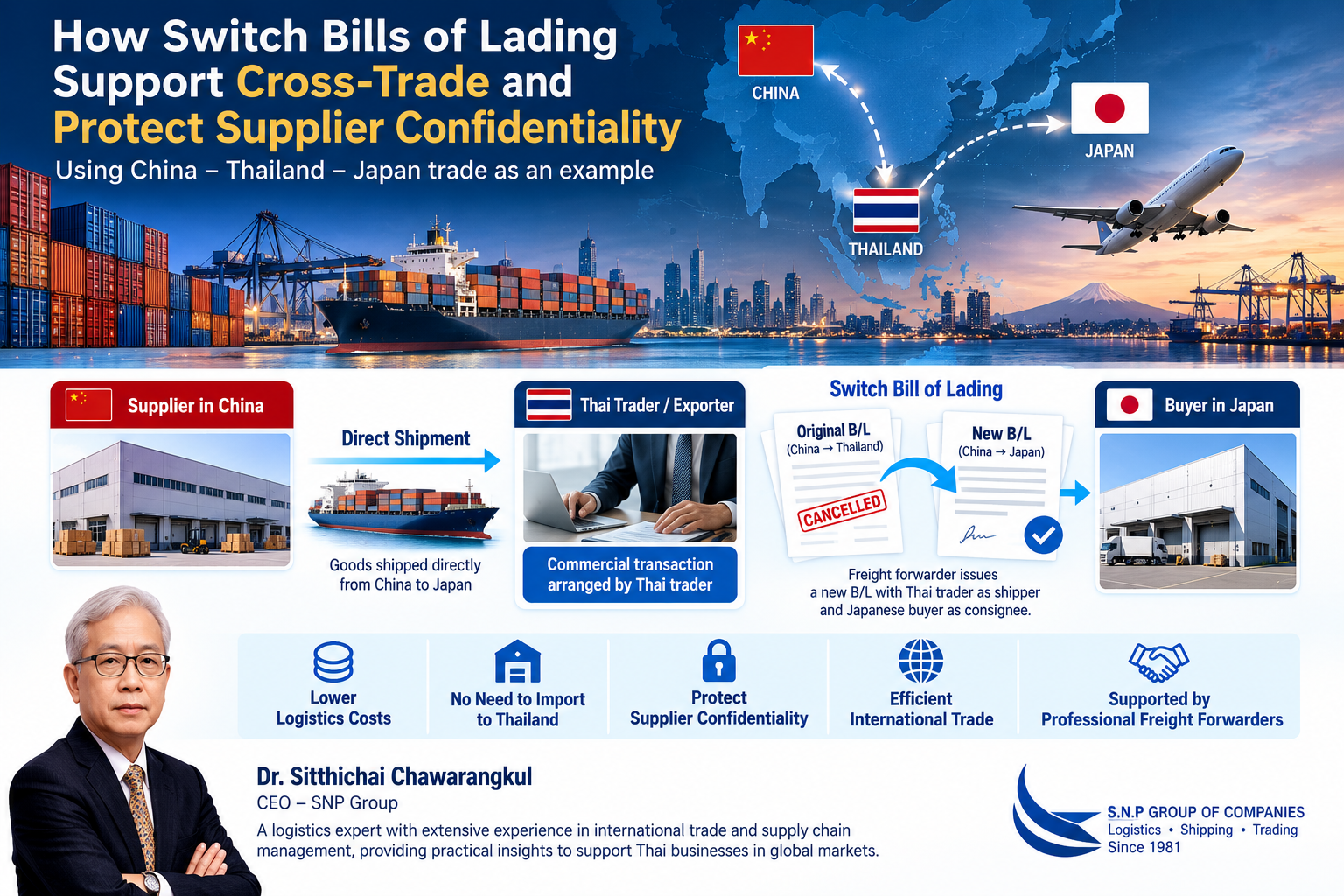

Thai exporters looking to act as a trade hub often encounter questions like these. A common scenario is a Thai exporter wanting to order products from a second country, such as China, and then sell them to a third country, such as Japan.
The conventional approach is to order and import the products from the second country to be stored in Thailand before distributing them to the third country at a later time. In this basic method, Thai exporters have two additional options: paying customs duties in Thailand to store the products in their own warehouse or not paying import duties, keeping the products at the port of entry, and then importing and exporting them to the third country simultaneously. In the latter case, labels or packaging may be changed within the export port area without paying import duties, and labels or packaging can be changed before export.
While these methods are commonly used, they do not address the issue of achieving low logistics costs. This is because shipping, handling, storage, and other costs associated with both import and export processes can be significant.
To achieve low logistics costs when sending products from the second country to the third country, and to prevent the buyer in the third country from knowing the origin, there seems to be only one viable method: instructing the seller in the second country to directly arrange for the shipment of the products to the third country.
However, if the Thai exporter does not understand the system, this method may inadvertently reveal the end recipient in the third country to the seller in the second country and vice versa. Understanding the concept of "Switched B/L" or "Switched Bills of Lading" can simplify this process.
Bills of Lading (B/L) are documents that represent the rights to the goods issued by the transport agent or vessel to the exporter. B/L contains essential information such as the product name, quantity, weight, volume, sender, receiver, departure port, and destination port.
There are two types of B/L: Ocean B/L (OB/L) issued by the cargo carrier or the agent directly appointed by them, and Forwarder B/L (HB/L) issued by the freight forwarder who manages the transportation of goods between countries.
Switching B/L can be easily done with HB/L. The freight forwarder in the second country, acting as the recipient, issues an HB/L to the Thai exporter, stating Thailand as the destination and the Thai exporter as the recipient. Meanwhile, the actual goods are sent directly to the buyer in the third country.
Upon receiving the HB/L from the seller in the second country, the Thai exporter brings it to the office of the local freight forwarder to request a switch to a new HB/L. The new HB/L indicates the buyer in the third country as the recipient, the Thai exporter as the sender, and other relevant information. This system is known as "Switched B/L."
With Switched B/L, the buyer of the products in the third country will not be aware of the origin of the goods. This collaboration between freight forwarders with distributed offices in various countries benefits Thai exporters by serving as a central hub for international trade, reducing logistics costs effectively.
For additional information or inquiries,

Dr. Sitthichai Chawarangkul
CEO – SNP Group of Companies
Website: http://snp.co.th
please contact us directly at 0-2333-1199.
Dr. Sitthichai Chawaranggoon, CEO of SNP, leads a dynamic logistics firm in meeting the global demand for seamless goods movement. Recognized for its SPEED, NETWORK, and PROFESSIONALISM, SNP excels in international supply chain solutions.
Key Points:
Emphasizes a 'happy workplace' for staff, correlating employee contentment with positive outcomes for shipments and customer satisfaction.
SNP maintains specialist status through regular in-house training, enabling smooth operations under Free Trade Agreement conditions.
Dr. Chawaranggoon's educational journey includes a Ph.D. in Business Administration, complementing his practical expertise.
As a visionary leader, Dr. Chawaranggoon's strategic approach ensures every shipment is professionally handled, solidifying SNP's position as an industry leader in international logistics.
